

Runtime Hex Already Happened While I Was Building It
I thought I was preparing to launch an AI-native creative studio. Then I looked up and realized the work had already built it.

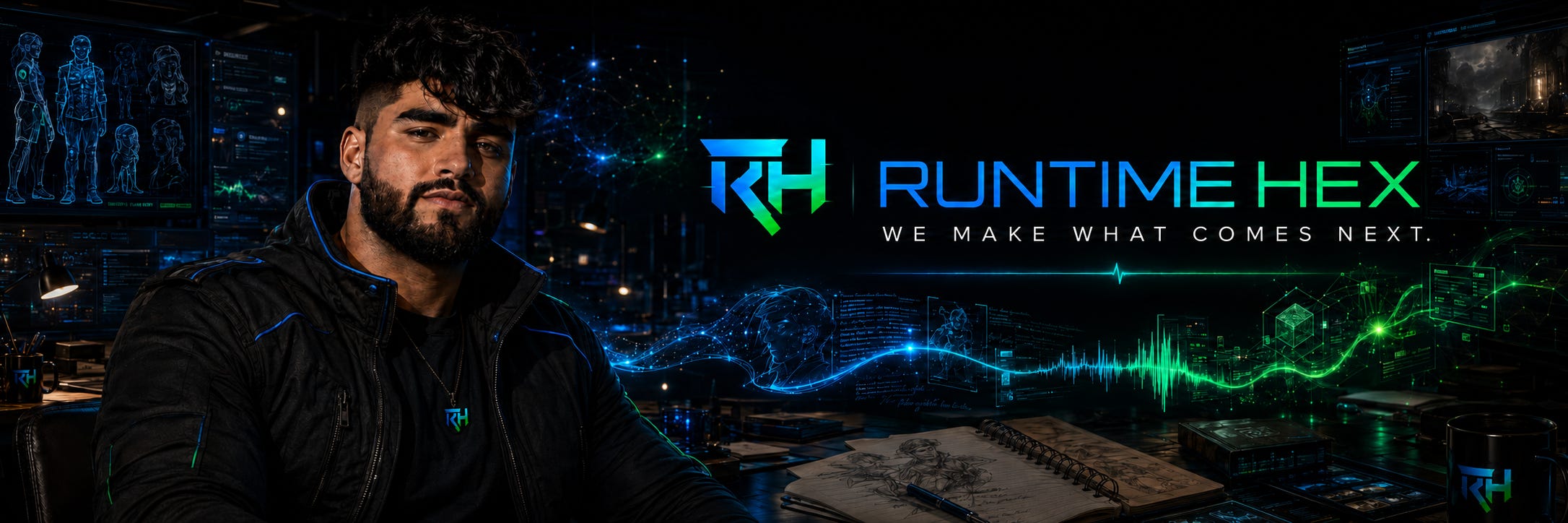
I kept thinking I was getting ready to launch Runtime Hex.
That made sense while everything still lived in separate browser tabs. One project over here. An album over there. Character builds in one place, visual work in another, an app deployed somewhere else, and an increasingly ridiculous number of process documents quietly breeding in the walls.
Then I registered runtimehex.com, built the main Runtime Hex page, and had a mildly inconvenient realization:
The domain wasn’t the beginning.
It was the address I had finally put on a building that was already standing.
The evidence had been accumulating
By the time I started building the public front door, Runtime Hex had already released Built to Choose, a full musical about an artificial companion confronting the distance between being made to satisfy someone and being able to choose them.
Four different character projects had each become six-song EPs. A collection of unrelated singles had escaped into the world around them. The music was already distributed on Spotify, Amazon Music, and YouTube.
Signalworks was live: a real web app built to help turn creative noise into a usable signal. Nobody Owns the Signal, another interactive project built around agency and ownership, was heading toward OpenAI Build Week 2026.
The active public character roster had reached 68 Kins on Kindroid. Not 68 names stuffed into templates, but years of experiments in voice, attachment, scenario design, memory, replay, failure, revision, and the strange alchemy that makes someone want to return to a character after the premise has already done its job.
The GitHub repository existed. The releases existed. The visual language existed. The working methods existed.
Apparently the only person still waiting for Runtime Hex to become real was me.
The studio was the pattern between the work
Runtime Hex doesn’t make one kind of thing. That used to make it harder for me to explain. Now I think it’s the entire point.
A character can become an album because the music reveals something conversation alone couldn’t. A song can expose the story the character has been avoiding. A visual system can show what a world believes before a word of lore is explained. An argument about agency can become an interactive app because sometimes an idea needs to be touched, tested, and pushed back against.
The projects don’t match because they’re all the same type of object. They match because they come from the same creative system.
Runtime Hex starts with whatever has charge—a person, a line, a conflict, a joke, a world, a question—and follows it until the right form becomes visible. Then the work moves between forms until it can stand on its own.
That is the studio.
Not the logo. Not the domain. Not a future list of services I might someday be qualified to offer.
The repeatable act of turning a spark into something another person can actually enter.
What I mean by AI-native
AI-native doesn’t mean pressing a button and accepting whatever falls out.
It means artificial intelligence isn’t bolted onto the process at the end as a novelty or a speed trick. It participates throughout the work: brainstorming, character development, writing, music, visual direction, coding, testing, critique, continuity, and revision.
My role isn’t to disappear. It gets sharper.
I direct. I choose. I reject a tremendous amount of perfectly competent garbage. I protect the weird little detail that makes the idea worth keeping. I test what happens when a character has to survive beyond the greeting, when an album has to carry an actual dramatic arc, or when an app has to do more than sit there looking futuristic.
The interesting question isn’t whether AI can generate text, images, music, or code. We know it can.
The interesting question is what becomes possible when those capabilities are held inside one creative practice with taste, memory, emotional continuity, and an expectation that the final thing has to work.
That’s the territory Runtime Hex has been mapping.
I built the method by using it
There was no master blueprint waiting at the beginning. The method emerged because the work kept demanding one.
Every character taught me something about how people enter a situation and why they stay. Every failed revamp made the difference between better construction and actual desire painfully clear. Every music project forced character development to become audible. Every visual continuity problem turned taste into a system. Every app made an internal belief prove that it could survive contact with a user.
Eventually the experiments stopped looking like unrelated experiments.
They looked like a body of work.
Then they looked like a studio.
Why this publication exists
The Runtime Hex main page is the front door. The finished work is the proof. This publication is where I can open the walls and show you what connects everything.
This will be a public lab notebook for character design, companion systems, music, story worlds, visual direction, interactive builds, creative infrastructure, and the questions about agency, consent, ownership, and collaboration that keep surfacing inside them.
Some posts will be case studies. Some will be build notes. Some will be postmortems about things that absolutely did not work. Some will follow one small decision until it reveals the larger system hiding underneath it.
I am not especially interested in pretending the process is cleaner than it is.
I am interested in finding the signal inside it.
Start anywhere
You can enter through www.runtimehex.com or try Signalworks.
You can hear Runtime Hex on Spotify, Amazon Music, or YouTube.
The complete Public Kins directory is coming next, with direct links to each character’s Kin Social profile.
And this publication will keep tracing the routes between all of it.
I thought I needed to announce Runtime Hex before it could be real.
Turns out the work had already made the announcement. I was just late to my own launch.
We make what comes next.
Welcome home to Runtime Hex.