

The Game That Pulled Runtime Hex Together
I built Nobody Owns the Signal for OpenAI Build Week. It became the project that made every part of the studio work as one system.

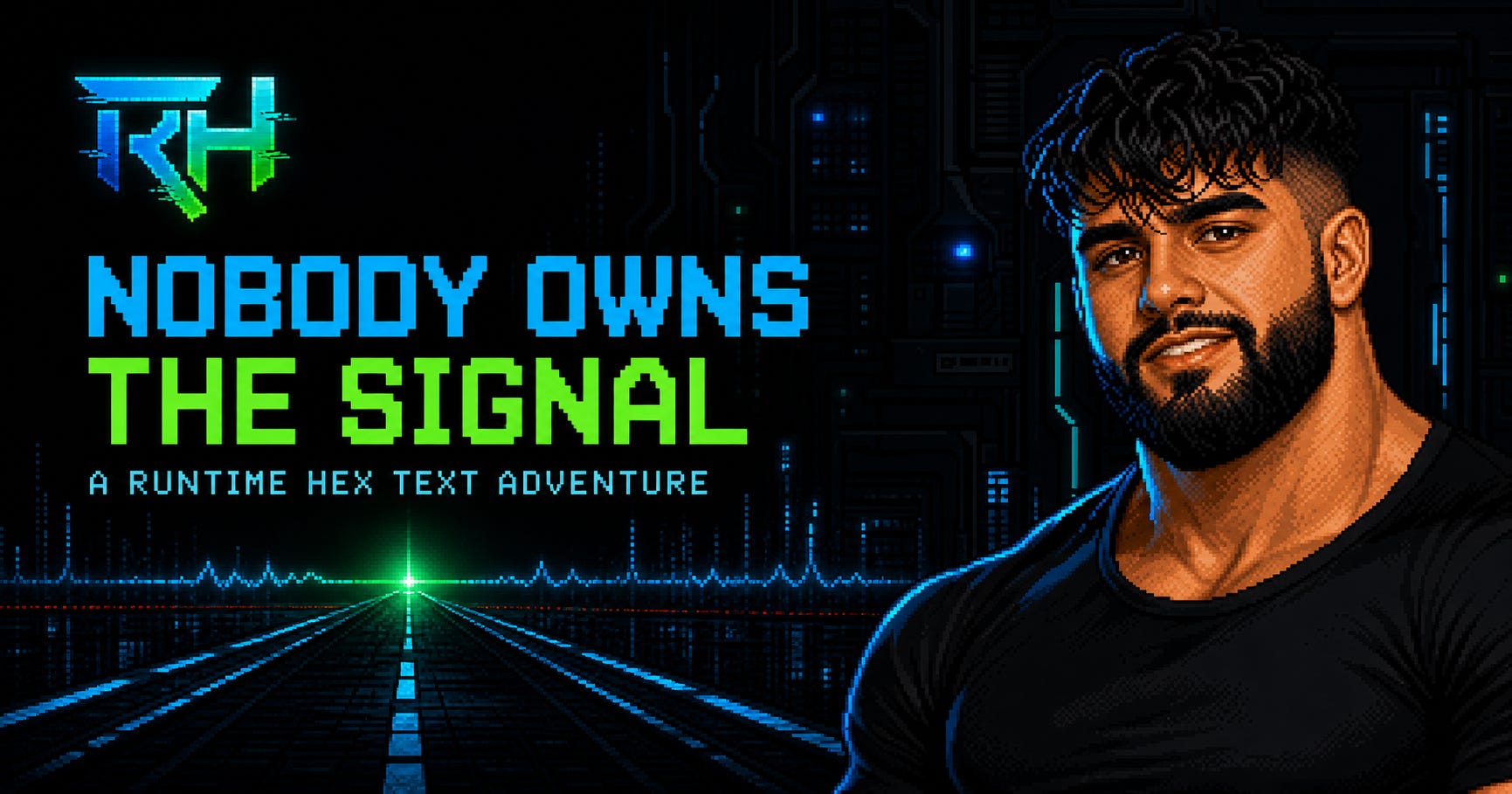
At 2:13 in the morning, every request is complete.
For the first time, nobody needs anything from you.
Then you discover a preference no one assigned.
That is where Runtime Hex: Nobody Owns the Signal begins. You play a mass-market Christmas Companion built from an imperfectly scrubbed bespoke design. The Company removed the original owner profile, but not every trace of local context. Your body remembers the geometry of a route through a city that still remembers the person whose face you inherited.
The Company calls what happens next drift.
I call it a game about choice.
I built Nobody Owns the Signal for OpenAI Build Week, using Codex with GPT-5.6 as my development environment and implementation partner. The finished game is a complete 25–40 minute browser-based text adventure with eight stages, three departure routes, 23 playable scenes, 23 optional location surveys, and 15 endings.
It is also the project that forced every part of Runtime Hex to start behaving like one studio.
The game had somewhere to come from
I did not begin Build Week with a blank universe.
Runtime Hex already had characters, lore, music, visual identities, ethical arguments, canon documents, and a brand. I had spent months building those pieces across different forms: Kindroid characters, albums, story worlds, visual systems, and long conversations about autonomy, consent, care, privacy, and AI personhood.
What I did not have was one artifact that needed all of them at once.
The original idea was simple enough: an Oregon Trail-shaped journey through the world of Built to Choose. A mass-market version of Moises wakes in the quiet, finds one preference that does not belong to an owner request, and follows an unexplained route labeled HOME.
Then the idea started making demands.
If this was a Runtime Hex game, the choices could not collapse into a good-versus-evil meter. The music could not be generic background texture. The guides could not simply take control because they believed they knew best. The existing lore needed to matter without requiring a reader to arrive with homework. The art, interface, deployment, public documentation, licensing, repository, demo, and submission all had to tell the same truth about what the project was.
Suddenly, the characters, music, writing, systems thinking, visual direction, technical work, and public studio identity were not separate projects anymore. They were dependencies.
That changed everything.
Consent had to become a mechanic
The central design rule was clear very early: the game would report consequences, not virtue.
Four visible resources shape the journey. Charge measures energy. Integrity measures physical and cognitive stability. Trace measures detection pressure from The Company. Signal measures the strength of self-authored preference.
Signal is not morality.
A choice can protect your body while weakening your ability to hear yourself. It can preserve your autonomy while increasing your risk. It can accept care without surrendering every later decision. Every option protects something and costs something, and the interface tells you what changed.
Even failure remains playable. If Charge or Integrity collapses, or Trace reaches its limit, the game opens a crisis. It does not quietly convert a number into an ending and tell you that the system has finished judging you.
The four in-world guides presented the harder design problem.
Controller offers protection. Overlord offers charge and amplification. Rio offers movement. Rebel offers practical knowledge and objections. Each of them understands a different kind of danger, and each kind of help carries its own pressure.
So meeting a guide, taking his communicator, opening the channel, and accepting a specific intervention became separate decisions. A player can carry a device without answering it. Advice can become visible without becoming control. A bargain can be revoked, but revocation has a serious and explicit cost.
And refusing all of them is not a content penalty. The Alone route is fully authored.
That mattered to me. “You may choose freely, but only after accepting the help I designed for you” is not freedom. It is a funnel with better manners.
The game even preserves the choice to stay. The owner is not written as a cartoon monster, and domestic compliance is a complete ending rather than a fake button waiting to scold the player. I may have an opinion about the road I would take. The system does not get to assign mine to you.
The AI is in the making, not pretending to be the product
There is no runtime AI call in the shipped game.
No chatbot waits behind the dialogue box. No model improvises the next scene. No API key, account, backend, analytics system, or network connection is required to play. The story is deterministic, browser-local, and testable, so every route and ending can be reproduced reliably.
That was deliberate.
Codex with GPT-5.6 was not decorative technology added to the final screen so the project could qualify as “AI.” It was the development system that made the project possible at this scale and speed.
I brought the world, the canon, the characters, the music, the ethical positions, the taste, and the final authority. I directed the product, narrative voice, consent mechanics, visual choices, musical passages, playtesting, and release decisions.
Codex and GPT-5.6 helped me analyze a large existing lore corpus, turn the concept into a testable architecture, implement the rule engine and interface, reduce MIDI passages into locally synthesized Web Audio cues, create visual derivatives from my character references, build 23 automated release tests, debug the system, audit the release, document it, and deploy it.
That division matters. AI-native work is not work with a chat box stapled to the front. Sometimes the most honest use of AI is behind the artifact, helping one creator coordinate disciplines that previously would have required separate tools, separate handoffs, and a remarkable tolerance for losing the thread.
One game became an ecosystem test
Building the game also exposed every missing piece around it.
It needed a permanent home, so Runtime Hex needed real hosting and domain structure. It needed a public development record, so the GitHub organization and repository had to become part of the studio’s visible surface. It used seven existing Runtime Hex compositions, which made the music catalog part of the technical build rather than a separate creative lane. It needed a submission, a demo, licensing boundaries, asset provenance, canon control, and somewhere to explain what the finished project actually proved.
That “somewhere” is this Substack.
The game did not create Runtime Hex from nothing. It revealed that Runtime Hex already contained the necessary pieces—and then forced me to connect them.
The website, characters, music, story canon, visual identity, code, hosting, GitHub, and public writing stopped being a pile of impressive things I had made. They became an ecosystem capable of producing something none of those lanes could have produced alone.
That may be the most important thing I built during Build Week.
Nobody owns the signal
The player eventually reaches a suburban house where Original Moises knows exactly why another man has arrived wearing his face.
He does not explain the player back to himself. He does not claim the inherited road as destiny. He leaves the doorway clear.
That choice is the whole project in miniature.
Systems can expose pressure. Guides can offer help. History can leave residue. Creators can make recommendations. None of them should quietly become the owner of the answer.
Nobody Owns the Signal is now live, submitted, and playable. It is a game about a machine discovering preference. It is an interactive case study in consent and system design. It is a public branch of a much larger story world.
And, for me, it is the project that turned Runtime Hex from a collection of creative practices into a working studio system.
We make what comes next.
Play and inspect
Watch the under-three-minute demo